Getting this one right has real consequences. Bees are important pollinators and, in most cases, should be moved by a beekeeper rather than killed. Wasps usually do not get that treatment. Mix them up and you either destroy a beneficial colony for no reason or walk up to a defensive one as if it were harmless. In Washington County, where Africanized honey bees have been found, that second mistake carries extra risk.
Body Shape
The quickest way to tell.
Bees are stocky and rounded, with bodies covered in visible hair. That hair has a job: it picks up pollen. Honeybees are golden brown with darker stripes. Bumblebees are big, very fuzzy, and banded in black and yellow. Southern Utah also has many native desert bees, from tiny sweat bees to large black carpenter bees.
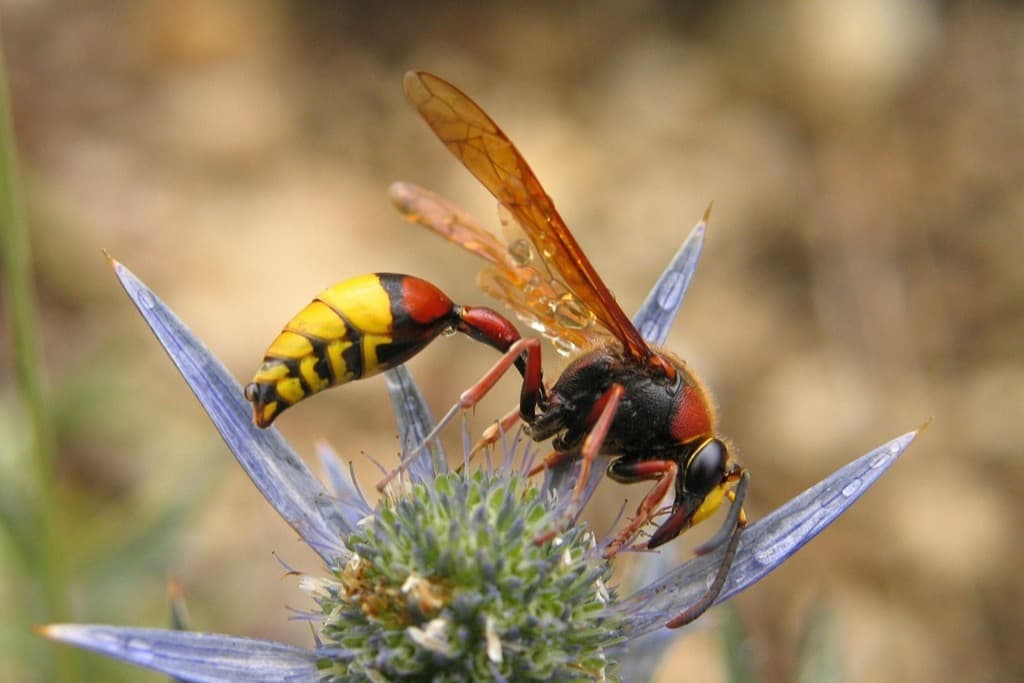
Wasps are slim and smooth, with a sharply pinched waist between the chest and abdomen and little or no hair. Their colors tend to be brighter and shinier: vivid yellow and black, or rusty red and brown in many paper wasps.
Fuzzy and chunky means bee. Sleek with a narrow waist means wasp.
Legs In Flight
A good backup check.
Bees pull their legs up under the body in flight, and honeybees often carry bright yellow or orange clumps of pollen on their back legs.
Wasps let their legs hang down. Paper wasps have long legs that dangle obviously, so you can often identify them from several feet away.
Diet
Bees eat only nectar and pollen. They have no interest in your lunch.
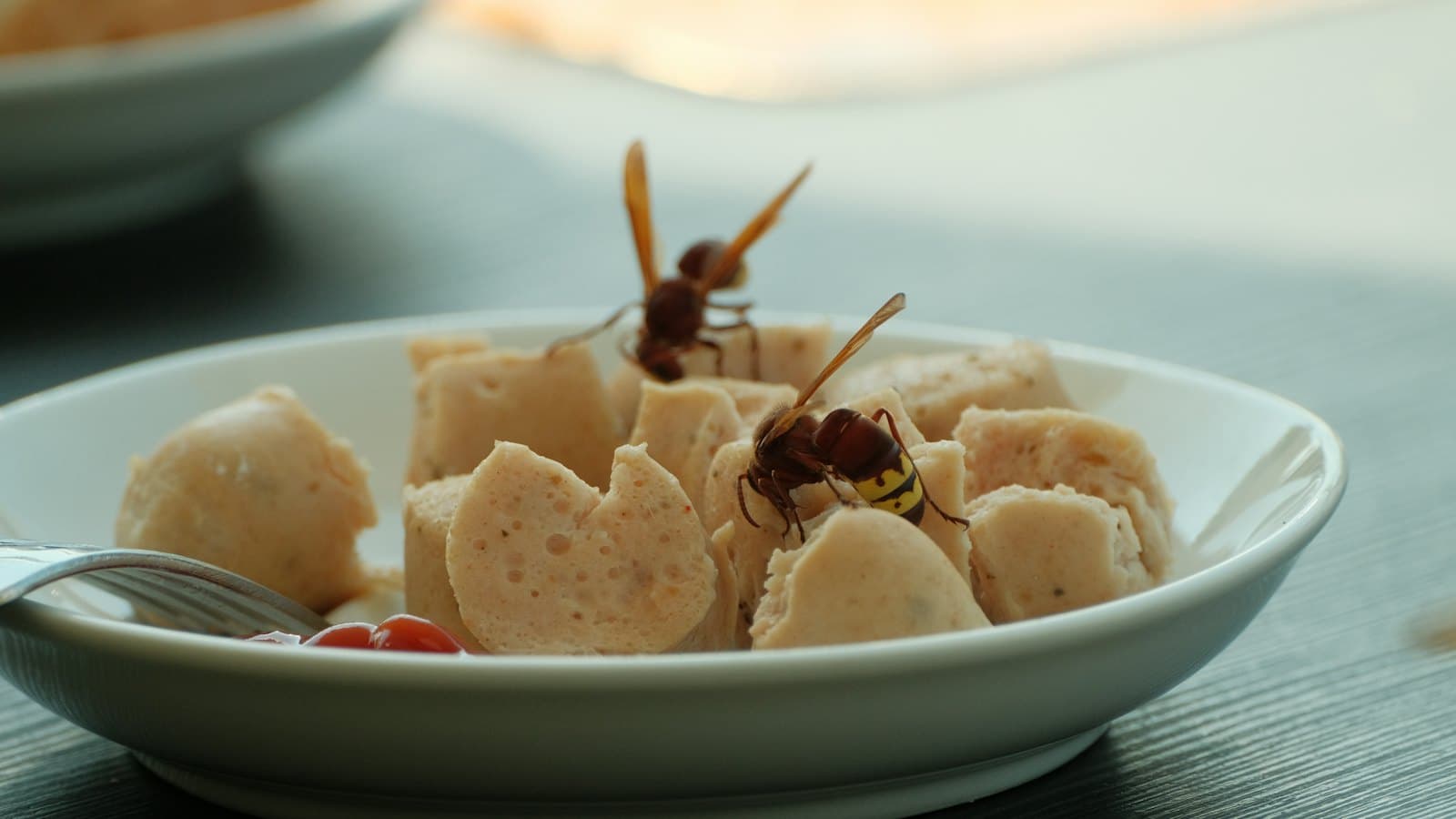
Wasps hunt and scavenge. They catch insects for protein and, late in the season, go after sugar hard.
This is the difference that matters most day to day: if it is landing on your soda, your sandwich, or your trash can, it is a wasp. Bees do not do that.
Nests
Honeybees build wax comb inside enclosed spaces: tree cavities, wall voids, chimneys, meter boxes, irrigation valve boxes, and hollow block walls, which are everywhere in St. George. Colonies are big, often tens of thousands of bees, and they live for years.
Bumblebees nest in small cavities, often underground in old rodent burrows or beneath sheds. Colonies are small, a few hundred at most, and die off each year.
Solitary bees, which make up most bee species, each build their own nest in soil, hollow stems, or holes in wood. Mason bees, leafcutter bees, and carpenter bees belong here. They are gentle and very useful.
Wasps make nests from chewed wood fiber that dries into paper. Paper wasps build open, umbrella-shaped combs under eaves, patio covers, and the edges of tile roofs. Yellowjackets build enclosed nests in the ground or inside walls. In our mild climate, paper wasp and yellowjacket colonies can stay active late into the year, but nests are generally not reused.
Mud daubers build small tubes of mud. They live alone and are harmless.
Stinging Behavior
Honeybees have barbed stingers that tear out when used, killing the bee. They sting only to defend the colony or when trapped. A single honeybee working a flower is not a threat.
Africanized honey bees look the same but behave very differently near the nest. They react to disturbance faster, send out far more defenders, and chase people much farther. You cannot tell them apart from regular honeybees by eye, which is why any established honeybee colony near a home here should be handled by a professional.
Bumblebees can sting more than once but rarely do unless they are grabbed.
Wasps have smooth stingers and can sting repeatedly. Social species defend the area around the nest fiercely, and yellowjackets attack in groups.
If you were stung once and a stinger stayed in your skin, it was a honeybee. Multiple stings from one insect point to a wasp.
Seasonal Behavior
Honeybee colonies survive winter as a cluster inside the nest. Swarms, which can look frightening, are a colony splitting to reproduce. A swarm hanging from a branch is usually passing through and is generally calm, because it has no home to defend yet. Here, though, a swarm could be Africanized, so keep your distance and call for help rather than approaching it.
Wasp colonies decline as the year ends. Mated queens find shelter, wait out the cool months, and start new nests in spring.
What To Do With Each
Honeybee swarms and colonies: keep people and pets away and call a professional or an experienced local beekeeper. Swarms can often be collected and relocated. Colonies built into walls or block walls take more work, including removing the comb. Do not spray them, and do not try to remove them yourself.
Bumblebees: leave them be if you can. They are great pollinators, the colonies are small, and they die off on their own. Consider relocation only if the nest is right in a busy spot.
Solitary bees: leave them entirely. Mason, leafcutter, and native desert bees are valuable and pose very little risk.
Paper wasps: remove nests near doors, walkways, patios, and play areas. Nests well out of the way can stay, since paper wasps eat a lot of caterpillars.
Yellowjackets: professional removal, especially for ground nests and anything large or late in the season.
Mud daubers: let them be. They hunt spiders, black widows included.
When Identification Is Difficult
Some flies, like hoverflies and drone flies, look a lot like bees but cannot sting. If it has two wings instead of four and very large eyes, it is a fly.
If a colony is inside a wall and you cannot get a good look, do not seal the hole. If they are honeybees, sealing them in leaves comb and honey inside the wall, which draws other pests and can damage the structure. Find out what they are first.
If you have a nest or colony on your St. George or Washington County property and are not sure what it is, contact Butter Pest Control. We will identify it, remove wasps safely, and make sure bees are handled by the right people.
Dealing with this pest at your place?
Butter serves St. George and southern Utah with free inspections and a re-treatment guarantee. Get an honest quote, no pressure.
Aspen Chournos
Aspen Chournos writes about desert pest pressure and prevention for homes and businesses across St. George and southern Utah.